
Owner Explainer: Tesla Wiper Service Mode and Winter Visibility
Owner Explainer · Current Tesla Primary Documentation

Use Tesla Wiper Service Mode before lifting a wiper arm, put a towel between the arm and glass, and never force blades that are frozen to the windshield. Tesla’s current Model Y guidance says to inspect blade edges, replace damaged blades promptly, and use washer fluid with antifreeze below 40°F (4°C). Blade sizes and connectors are model-specific, so verify the live manual for your exact vehicle.
30-Second Brief
- This Owner Explainer was published October 9, 2026 in America/Los_Angeles under the mandatory fallback ladder. It does not claim Tesla announced a new wiper feature today.
- Wiper Service Mode moves the arms to a maintenance position; it is not a de-icing program and does not make a frozen blade safe to move.
- Tesla says to remove ice before using the wipers and, on vehicles without wiper defrosters, to use the service position so the blades can thaw with the windshield.
- The cited current Model Y page lists 26-inch driver and 20-inch passenger blades, but connector and size can vary by vehicle generation and market.
- Ineffective wipers can reduce the front cameras’ visibility, so cleaning and replacement are visibility maintenance, not merely cosmetic work.
What Happened
Tesla’s current winter-driving, owner-manual and do-it-yourself pages place several related instructions in different locations: how to expose the wiper arms, how to handle ice, which washer fluid boundary applies in cold weather, and how to replace current Model Y blades. This explainer brings those existing instructions together for owners entering the colder and wetter part of the year.
The subject is maintenance guidance, not a new product announcement, recall or software rollout. Public owner discussions were reviewed only as an interest signal; every factual instruction below comes from Tesla’s directly readable documentation.
What Is Confirmed
- Service position: Tesla directs owners to shift into Park, turn the wipers off and select Controls > Service > Wiper Service Mode before lifting the arms.
- Glass protection: Tesla says to lift the arm only far enough to reach the blade and place a towel between the arm and windshield.
- Ice boundary: Tesla warns that ice can damage blade rubber and says the blades must not be frozen or adhered before operation.
- Defroster availability: some vehicles have wiper defrosters. Tesla says vehicles without them can use the service position while the windshield defrosts.
- Fluid boundary: the cited current Model Y manual says to use washer fluid with antifreeze below 40°F (4°C) and to avoid formulas that cause streaking or smearing.
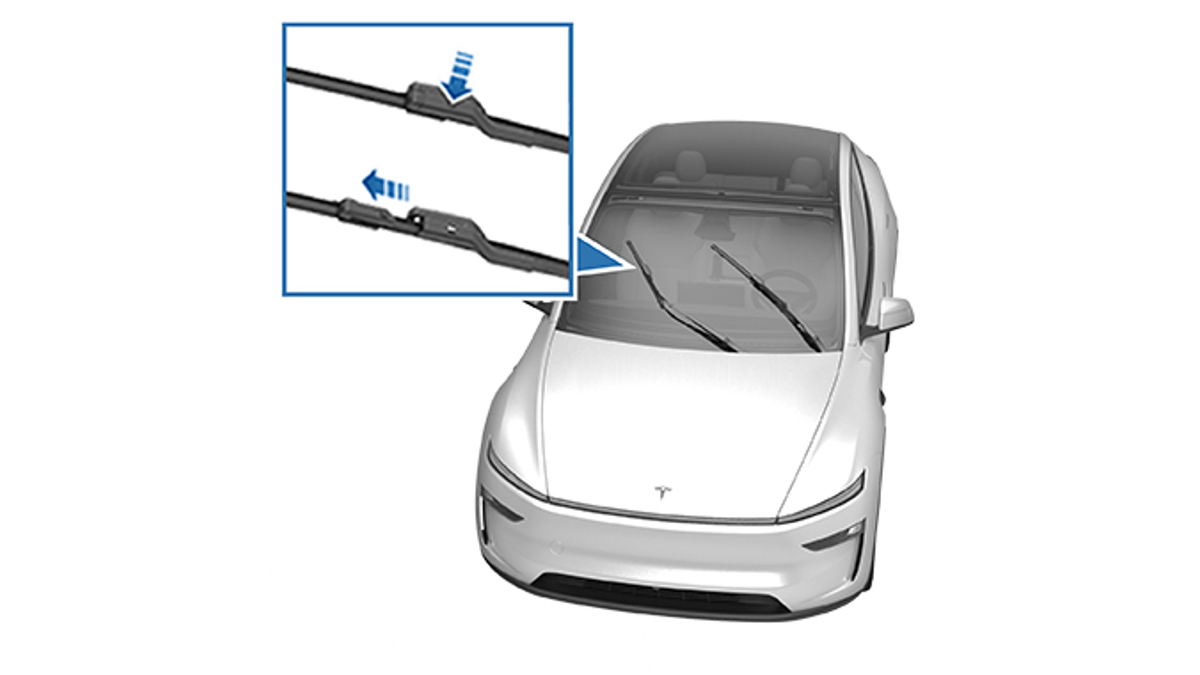
- Inspection: Tesla says to clean blade edges, inspect for cracks, splits and roughness, and replace damaged blades promptly.
- Current Model Y specification: the cited page lists a 26-inch driver blade and a 20-inch passenger blade, plus a requirement to match the original connector.
- Camera impact: Tesla states that ineffective wipers can reduce front-camera visibility and may degrade or make Self-Driving features unavailable.
What Remains Unconfirmed
There is no universal Tesla blade size, connector, defroster configuration or replacement path. The Model Y dimensions above are taken from the cited current North American documentation and should not be generalized to Model S, Model 3, Model X, Cybertruck, older Model Y generations or another market.
Wiper chatter or streaking does not by itself identify a failed blade. Contamination, wax, water-repellent products, damaged glass, a bent arm, blocked washer jets or unsuitable fluid can produce similar symptoms. This article does not diagnose a vehicle or replace the model-specific manual.
Why It Matters
Visibility failures often become obvious only after rain, spray, frost or road salt arrives. A weak blade can leave glare and streaks for the driver while also obscuring camera views used by assistance features. Tesla’s documented sequence—clean, inspect, verify fluid, then replace if still ineffective—avoids treating every visibility problem as the same fault.
The service-mode boundary also protects hardware. Pulling an arm from its normal parked position can bring it close to the hood edge, and letting an unsupported arm snap onto the glass can crack or scratch the windshield.
What Tesla Owners Should Know
- Start with the exact manual. Open Controls > Service > Owner’s Manual in the vehicle and confirm the procedure, blade sizes and connector for that configuration.
- Park and switch the wipers off. Then enable Wiper Service Mode before raising an arm.
- Clear ice first. Use the vehicle’s defrost functions and wait until the blade is free. Do not pull a frozen blade from the glass.
- Protect the windshield. Lift the arm only as far as instructed and place a folded towel between the arm and glass.
- Clean before replacing. Use an automotive-safe, non-abrasive cleaner approved for glass and rubber; avoid products that leave wax or water-repellent residue on the front windshield.
- Check cold-rated fluid. Use fluid suitable for the lowest expected temperature and follow the product’s eye- and skin-safety instructions.
- Match the connector. If replacing a blade, compare it with the original and perform Tesla’s push-pull check after it clicks into place.
- Test at low risk. Exit Service Mode and verify wipe and wash operation while parked before relying on the system in traffic.
- Escalate unresolved visibility problems. Schedule service if a blade will not lock, an arm appears damaged, jets stay blocked or the windshield remains unclear after the documented maintenance steps.
Tesstudio Analysis
The safest mental model is simple: Service Mode creates access, defrost frees the blade, cleaning removes contamination, and replacement addresses wear. None of those steps substitutes for the others.
The most important reporting boundary is model specificity. Tesla publishes a useful current Model Y size and connector guide, but a generic “Tesla wiper blade” purchase can still be wrong. Confirming the live in-car manual before buying is faster than discovering a mismatch with the arm lifted and the windshield exposed.
Related Tesla News Resources
For other cold-weather basics, see Tesstudio’s Tesla cold tire-pressure and TPMS explainer. For scheduled cabin and battery preparation, see the Scheduled Departure guide. No Related Gear module is included because the cited documentation does not establish one compatible blade or fluid for every Tesla configuration.
Sources & Reporting Notes
- Tesla Winter Driving Tips — primary guidance for wiper defrosters, Service Mode, ice preparation and cold-rated washer fluid.
- Tesla Model Y Owner’s Manual: Windshield Wiper Blades, Jets and Fluid — primary source for cleaning, annual replacement guidance, current Model Y sizes, connector matching and camera-visibility impact.
- Tesla Model Y Owner’s Manual: Wipers and Washers — primary source for manual controls, Auto-mode boundary and ice precautions.
- Tesla Model Y DIY: Replacing Wiper Blades — primary illustrated replacement procedure and connector-generation boundary.
Reporting note: Tesla documentation changes with model, manufacturing date, market and software. Owners should use the live in-car manual for their exact vehicle. No X API call was made because actual X billing could not be verified.
Update & Correction Log
October 9, 2026: Initial Owner Explainer. Published in mandatory fallback mode after more than ten hours without a new article and with zero Tesla News publications on the current America/Los_Angeles day. The story clearly distinguishes current documentation from a new announcement.


Laisser un commentaire
Ce site est protégé par hCaptcha, et la Politique de confidentialité et les Conditions de service de hCaptcha s’appliquent.