Tesla Recalls 20,349 Model 3 and Model Y Vehicles Over Bright Headlights
Confirmed · NHTSA Safety Recall 26V507
The Tesla headlight recall 2026, formally NHTSA Recall 26V507, covers 20,349 U.S. vehicles across certain 2017–2023 Tesla Model 3 and 2020–2023 Tesla Model Y configurations. NHTSA says their low beams may be brighter than federal rules permit. The remedy is still being developed, so owners should check their VIN and monitor official notices.
30-Second Brief
- NHTSA lists Campaign 26V507 for certain 2017–2023 Model 3 and 2020–2023 Model Y vehicles.
- Reuters reports a potential U.S. population of 20,349 vehicles.
- The low-beam headlights may exceed maximum light-output requirements in Federal Motor Vehicle Safety Standard 108.
- NHTSA says excessive low-beam brightness can reduce visibility for oncoming drivers and increase crash risk.
- The final remedy is not yet specified. Owner notification letters are expected to be mailed by September 15, 2026.
What Happened
NHTSA added Campaign 26V507 to its recall database after denying Tesla’s request to treat the headlamp photometry issue as inconsequential to motor-vehicle safety. The campaign applies to a defined subset of older Model 3 and Model Y vehicles, not automatically to every car built in the listed years.
The federal record says the low beams can exceed the maximum output allowed by FMVSS 108. That standard governs lamps, reflective devices and related equipment. The issue concerns the effect of excessive light on other road users, particularly the possibility of reducing an oncoming driver’s visibility.
What Is Confirmed
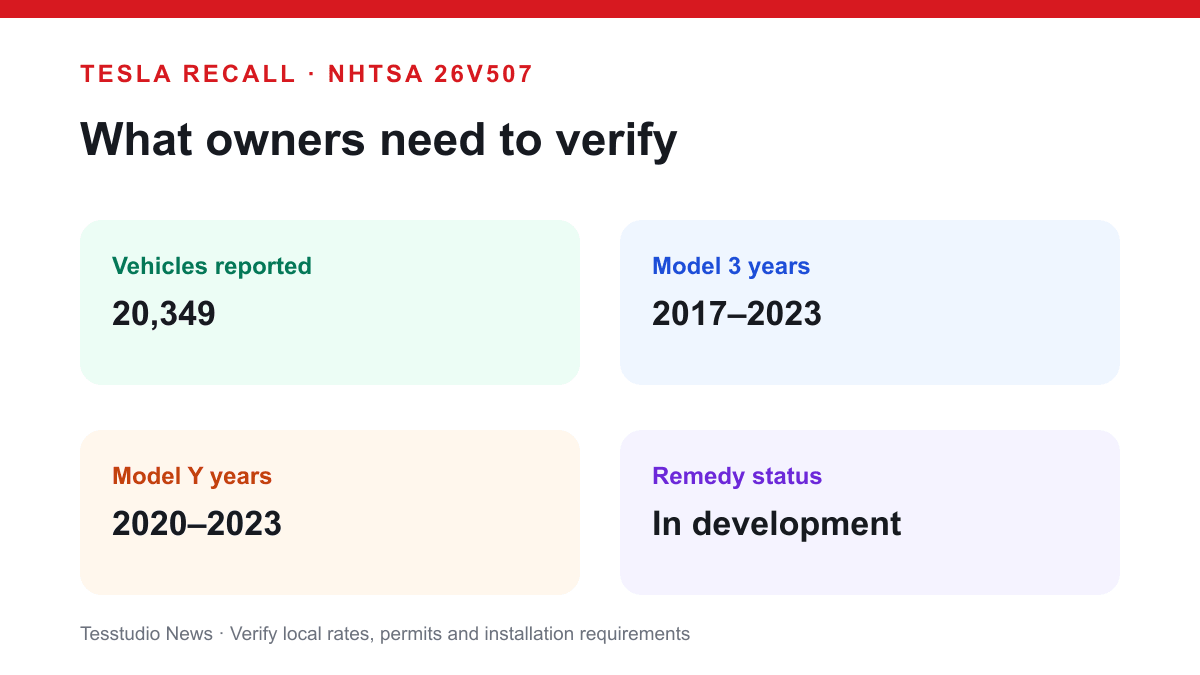
- Campaign: The NHTSA identifier is 26V507000; shortened references may appear as 26V507.
- Vehicle scope: Certain 2017–2023 Model 3 and 2020–2023 Model Y vehicles are included.
- Compliance issue: The affected low beams may exceed the maximum light output permitted under FMVSS 108.
- Safety consequence: NHTSA says overly bright low beams can reduce visibility for oncoming drivers and increase crash risk.
- Recall population: Reuters reports 20,349 U.S. vehicles, citing the regulator.
- Notification timing: NHTSA’s database says owner letters are expected by September 15, 2026.
What Remains Unconfirmed
The final repair method has not been published. NHTSA currently describes the remedy as under development, so owners should not assume the fix will be an over-the-air update or, alternatively, an in-person headlamp replacement or adjustment. Tesla and NHTSA will need to provide the final procedure.
The model-year ranges are not a substitute for a VIN match. They describe vehicles that may fall within the campaign, while manufacturing configuration and headlamp equipment determine whether an individual car is included.
Why It Matters
A recall can address a risk created for people outside the recalled vehicle. Headlights are a shared-road safety system: a driver needs enough forward illumination, but excessive output in regulated areas can impair the vision of approaching traffic.
This case is also a useful reminder that a federal noncompliance recall does not always mean a part has failed in ordinary use. Here, the regulatory issue is that specified headlamps may exceed a photometric limit. Owners should follow the official remedy even if they have not noticed an obvious lighting problem.
What Tesla Owners Should Know
- Check the full VIN. Use Tesla’s official VIN Recall Search and NHTSA’s recall lookup. Do not rely only on the model year.
- Save the campaign number. Reference NHTSA 26V507 and Tesla service campaign SB-24-17-003 when checking status.
- Wait for the official remedy. The final fix is under development. Avoid assuming that a generic headlight adjustment resolves the specific compliance issue.
- Watch for the owner letter. NHTSA currently lists September 15, 2026, as the expected mailing date.
- Do not install unrelated parts. This article contains no product recommendation because accessories cannot substitute for an approved recall remedy.
How do I know if my Tesla is affected by recall 26V507?
Enter the vehicle’s complete 17-character VIN in Tesla’s official recall search or NHTSA’s recall lookup. A 2017–2023 Model 3 or 2020–2023 Model Y is not necessarily affected simply because it falls within the listed model-year range.
Tesstudio Analysis
The practical owner decision is simple: verify the VIN now, then wait for the campaign-specific repair instructions. The less useful response is guessing whether the fix will be software, adjustment or replacement before Tesla and NHTSA publish the remedy.
The distinction between “potentially included model year” and “affected VIN” deserves emphasis. Broad recall headlines help people notice the issue, but the VIN record is what determines whether action is required for a specific vehicle.
Related Tesla News Resources
Follow the Tesstudio Tesla News hub for verified recall, software and regulatory updates. No Related Gear or buying CTA is included because only the approved recall remedy is relevant to this safety event.
Sources & Reporting Notes
- NHTSA Recall Campaign 26V507 — official campaign lookup.
- NHTSA Recalls API — official model-year scope, consequence and remedy status.
- Federal Register: Tesla petition denial — NHTSA’s decision concerning the headlamp noncompliance.
- Tesla VIN Recall Search — official vehicle-specific lookup.
- Reuters: Tesla to recall more than 20,000 U.S. vehicles — independent reporting on the newly listed campaign population.
Reporting note: Vehicle scope, safety consequence, campaign number and remedy status are taken from NHTSA. The population figure is attributed to Reuters. Tesstudio has not independently inspected affected headlamps and is not affiliated with Tesla, NHTSA or Reuters.
Update & Correction Log
August 12, 2026: Initial publication based on NHTSA Campaign 26V507, the Federal Register decision, Tesla’s VIN lookup and Reuters reporting. The remedy is explicitly labeled as pending.



Leave a comment
This site is protected by hCaptcha and the hCaptcha Privacy Policy and Terms of Service apply.