
IRS Finalizes Car-Loan Interest Deduction Rules: What Tesla Buyers Must Check
Confirmed · IRS Final Rule
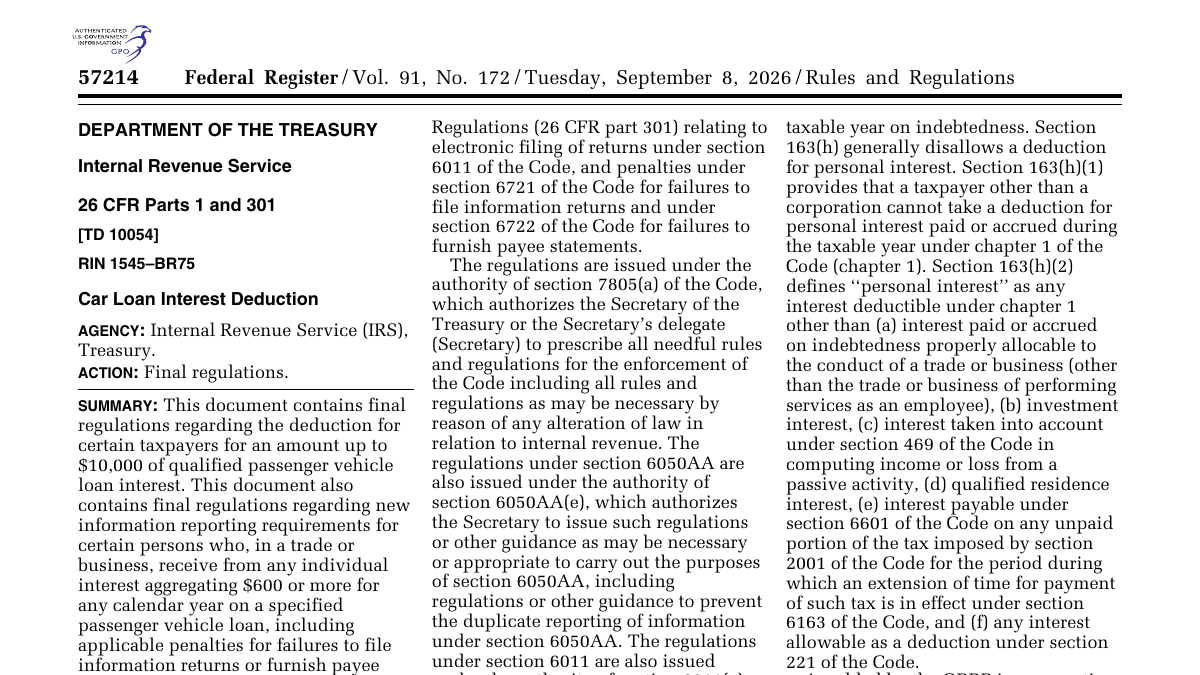
The new car-loan interest deduction may let an eligible Tesla buyer deduct up to $10,000 of qualified interest per Federal return per year for 2025 through 2028. It is not automatic: the buyer must check the specific VIN and U.S. final-assembly location, a qualifying purchase loan, original use, more-than-50-percent expected personal use and the modified-income phaseout. A deduction lowers taxable income; it is not a dollar-for-dollar tax credit.
30-Second Brief
- Treasury and the IRS published final regulations TD 10054 on September 8, 2026. The regulations are effective November 9, 2026.
- The temporary deduction applies for tax years 2025 through 2028 and can be used by taxpayers who itemize or claim the standard deduction.
- The annual ceiling is $10,000 per Federal return, not per vehicle, regardless of filing status.
- The loan generally must have been incurred after December 31, 2024 to buy a new, U.S.-assembled qualifying passenger vehicle for personal use and must be secured by a first lien.
- The rule does not establish that every Tesla or every financing arrangement qualifies. Check the actual VIN, purchase documents, assembly label and tax situation.
What Happened
The Treasury Department and IRS converted earlier guidance into final regulations for qualified passenger vehicle loan interest. The rule explains which vehicles, borrowers and loans count; how the annual cap and income phaseout work; how original use and personal use are tested; how final assembly can be verified; and how refinanced loans are treated.
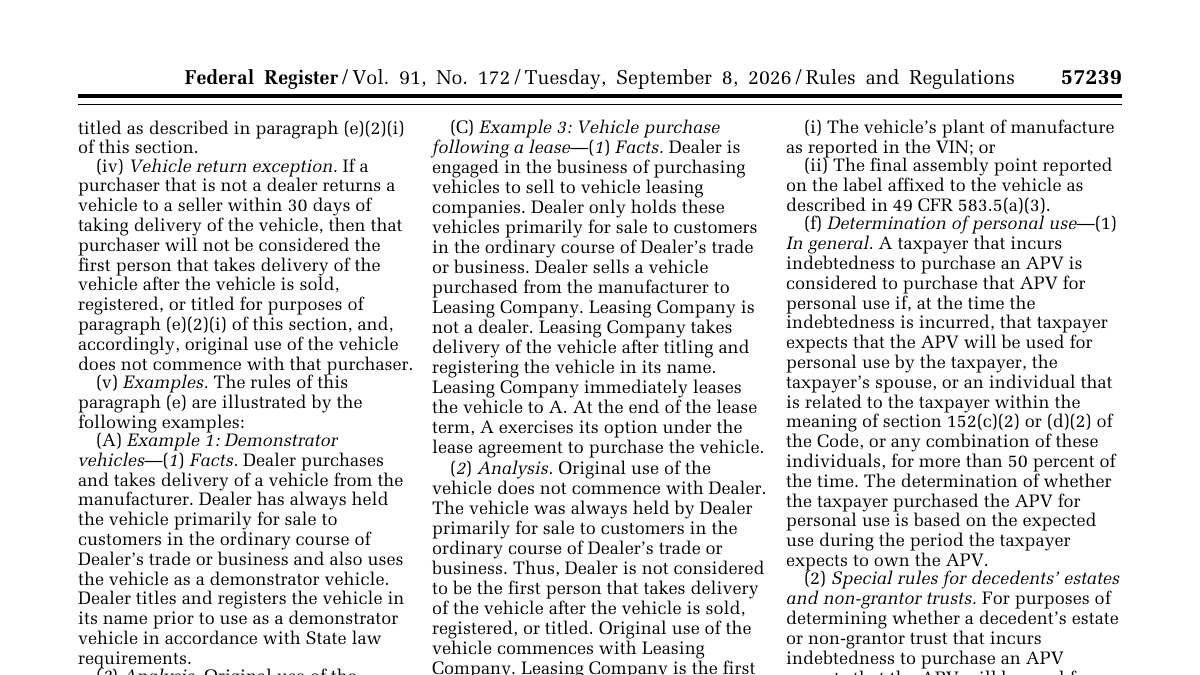
For Tesla shoppers, the practical change is greater certainty around documentation. The brand name is not the legal test. A buyer needs a qualifying loan and a qualifying individual vehicle, and the final rule directs taxpayers to verify U.S. assembly through the VIN's reported plant of manufacture or the final-assembly point on the vehicle label.
What Is Confirmed
- Timing: TD 10054 was published September 8, 2026 and becomes effective November 9, 2026. Its deduction rules apply to taxable years beginning after December 31, 2024 and before January 1, 2029.
- Annual cap: qualified interest taken into account cannot exceed $10,000 per Federal return per year, regardless of filing status.
- Income phaseout: after the dollar limit, the deduction is reduced by $200 for each $1,000 or part of $1,000 of MAGI above $100,000, or above $200,000 on a joint return.
- Vehicle requirements: the vehicle generally must be new to the taxpayer, made primarily for public-road use, fall within an eligible vehicle type, have a GVWR below 14,000 pounds and have final assembly in the United States.
- Loan requirements: the debt generally must have been incurred after December 31, 2024 for the purchase and be secured by the first voluntary lien on the vehicle. Credit-card debt is generally not secured by the vehicle and therefore does not meet that test.
- Personal use: at purchase, the taxpayer must expect more than 50 percent personal use over the period the vehicle is expected to be owned.
- Excluded structures: the regulation excludes lease financing, fleet loans, loans for non-personal commercial vehicles, salvage-title purchases and related-party debt. Refinancing can qualify only within the final rule's limits.
What Remains Unconfirmed
The final rule does not publish a blanket list declaring every Tesla model or configuration eligible. Factory sourcing can vary by vehicle, model year and VIN, so shoppers should not infer U.S. final assembly from the brand, order page or model name alone. The NHTSA VIN decoder reports the plant information supplied by the manufacturer, while the vehicle's Part 583 label provides another route named in the rule.
The maximum deduction also is not the same as the buyer's tax savings. Actual benefit depends on qualified interest paid, the per-return ceiling, MAGI phaseout and the taxpayer's marginal rate and overall return. Tesstudio cannot determine an individual's eligibility from a vehicle quote.
Why It Matters
Vehicle financing decisions combine price, interest rate, term, down payment and taxes. A temporary deduction changes one line in that calculation, but it does not erase the cost of borrowing. The strongest buyer response is better recordkeeping and a side-by-side after-tax comparison—not selecting a longer or more expensive loan simply to generate interest.
The rule also makes the VIN operationally important. Two vehicles with the same consumer-facing model name can require separate assembly verification. Tesla buyers should preserve the window sticker or final-assembly label, purchase agreement, loan documents, VIN and annual lender statement.
What Tesla Owners Should Know
- Confirm the purchase date and loan date. The qualifying debt generally must have been incurred after December 31, 2024.
- Check that the vehicle was treated as new. Used vehicles do not satisfy the original-use rule, and a lease payment is not qualified passenger vehicle loan interest.
- Verify final assembly by VIN or label. Use the NHTSA vPIC VIN Decoder and retain the vehicle label or window sticker.
- Confirm the lien. The loan must be secured by the vehicle as the first voluntary lien; unsecured borrowing generally fails this requirement.
- Estimate personal use honestly. The rule looks to expected use at purchase and requires more than 50 percent personal use over the expected ownership period.
- Apply the income phaseout. The $10,000 headline is a ceiling before the MAGI reduction, not a guaranteed deduction.
- Compare financing on total cost. A lower interest rate usually saves more than a deduction on additional interest. Ask a qualified tax professional about the individual return.
Tesstudio Analysis
Tesstudio scores this final rule 92.7. Source authority, factual confidence, novelty and timeliness are high because the same-day Federal Register publication, official printed PDF and current IRS guidance are all readable. Owner impact and search value are strong, while the article deliberately avoids assuming eligibility for an entire Tesla model line.
The useful takeaway is a five-part evidence chain: buyer, vehicle, assembly location, loan and income. If any link fails, the headline benefit may shrink or disappear. Buyers should treat the rule as a possible after-tax offset, not a reason to borrow more or pay a higher rate.
Sources & Reporting Notes
- Federal Register: Car Loan Interest Deduction, TD 10054 — final regulations published September 8, 2026.
- GovInfo: official printed version of TD 10054 — 31-page public PDF used for both article visuals and detailed rule checks.
- IRS Topic 505: Car Loan Interest Deduction — current IRS overview of the tax-year, loan, original-use and U.S.-assembly requirements.
- NHTSA vPIC VIN Decoder — official VIN tool identified by the final rule for checking plant-of-manufacture information.
Reporting note: This article reports general public guidance, not individualized tax advice. It does not claim that every Tesla, every buyer or every loan qualifies. Both visuals are unaltered-text crops rendered from the official Federal Register PDF and attributed to the U.S. Government Publishing Office.
Update & Correction Log
September 8, 2026: Initial publication based on TD 10054, the official printed rule, current IRS Topic 505 and NHTSA's VIN decoder. The article distinguishes a deduction from a credit and makes vehicle eligibility VIN-specific.



Leave a comment
This site is protected by hCaptcha and the hCaptcha Privacy Policy and Terms of Service apply.