
Verified Brief: Grok Voice 3.0 Launches at $0.08 a Minute With Automatic Alias Upgrade
Verified Brief · Same-Day Primary Release + Independent Benchmarks
Grok Voice 3.0 launched in the SpaceXAI Voice Agent API on October 14, 2026 at $0.08 per minute. Artificial Analysis lists an 86.9 composite score and 0.81-second time to first audio. Developers using grok-voice-latest were switched automatically, so production users should test the new behavior or pin a version.
30-Second Brief
- SpaceXAI released Grok Voice 3.0 on October 14, 2026 through its Voice Agent API.
- The company kept the headline price at $0.08 per minute, or $4.80 per hour.
- SpaceXAI says the grok-voice-latest alias now resolves to Grok Voice 3.0 without code changes.
- Artificial Analysis lists a composite score of 86.9, 71.6% on tau-Voice, 94.8% task success and 0.81 seconds to first audio.
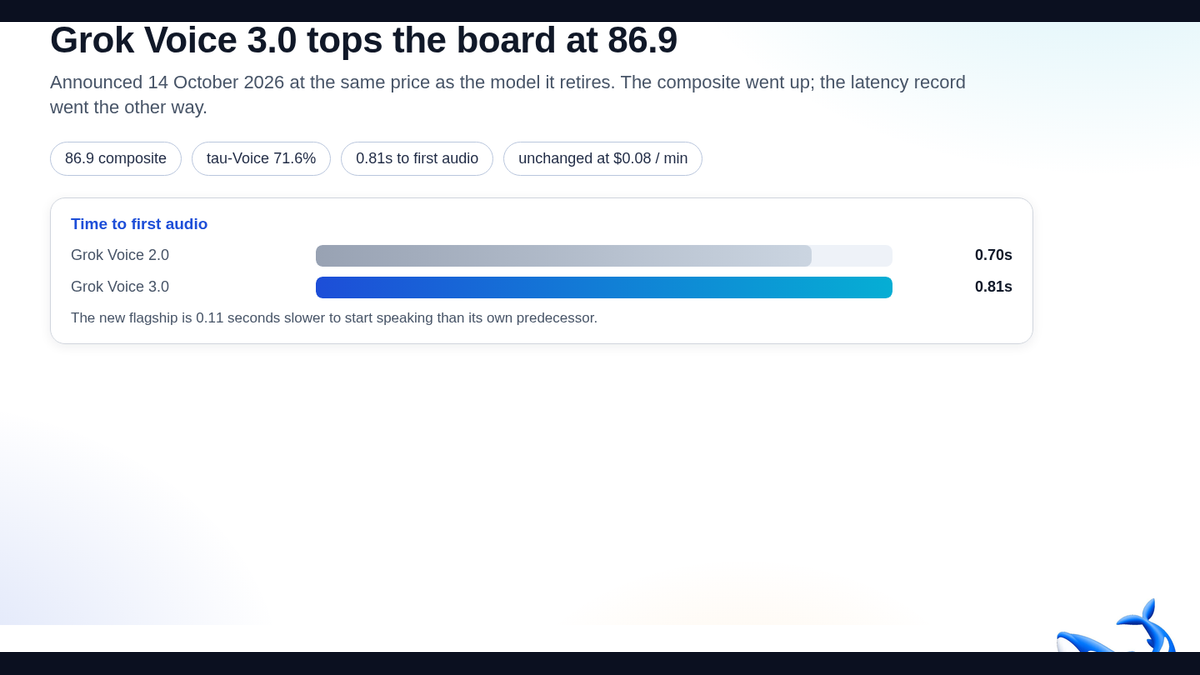
- The new model starts speaking 0.11 seconds later than Grok Voice 2.0 in the same independent table, despite a higher composite score.
- Tesla and Starlink usage figures in the launch post are company-reported and not independently audited.
What Happened
SpaceXAI launched a new speech-to-speech model for realtime voice agents. The API surface, authentication, session fields and voice set remain familiar, while the default latest-model alias has already moved from Voice 2.0 to Voice 3.0.
The release is material for teams running live phone or voice products because an alias change can alter behavior without an application deployment. SpaceXAI presents the model as stronger on support tasks and conversational handling; independent benchmark data support a higher composite result, while also exposing important tradeoffs.
What Is Confirmed
- Release date: SpaceXAI's official page is dated October 14, 2026 and names Grok Voice 3.0 as available that day.
- API price: SpaceXAI lists $0.08 per minute, unchanged from Voice 2.0.
- Alias behavior: the company says grok-voice-latest has already switched to the new model.
- Composite benchmark: Artificial Analysis lists Grok Voice 3.0 at 86.9 on its equal-weighted speech-to-speech index.
- Component results: the current independent table lists 98.5% speech reasoning, 97.0% conversational dynamics, 71.6% agentic performance, Elo 1070, 94.8% task success and 0.81 seconds to first audio.
- Important comparison: GPT-Live-1 with Astra medium scores higher on tau-Voice at 74.5%, while Grok Voice 2.0 starts speaking faster at 0.70 seconds.
What Remains Unconfirmed
SpaceXAI says Grok Voice handles millions of daily Tesla conversations and 20,000 Starlink support calls, with roughly 70% resolved without a person and one in four sales calls ending in a purchase. Those are company-reported system figures. The reviewed independent sources do not expose the traffic logs, prompts, escalation rules or transaction records needed to audit them.
Short benchmark interactions also do not establish long-session stability, noisy-call performance under every accent or production latency under load. A composite leaderboard position should not be treated as proof that one model is best for every voice product.
Why It Matters
The most immediate operational change is silent migration through the latest-model alias. A team that intentionally accepted automatic upgrades may benefit without touching code, but regulated or customer-facing systems may need a pinned version, a regression suite and a rollback path.
The benchmark shape is more useful than the headline rank. Voice 3.0's largest gain is on agentic task completion compared with its predecessor, while raw task-success movement is small and time to first audio is slightly slower. That points to better multi-step support behavior rather than a universal improvement in every dimension.
What Tesla Owners Should Know
- No vehicle software rollout is established here. The announcement identifies Tesla as a production user, but it does not name a Tesla firmware version, hardware requirement, country list or vehicle eligibility table.
- Treat usage totals as company claims. Millions of Tesla conversations per day are not independently audited in the reviewed material.
- Do not infer new driving capability. Grok Voice is an assistant and API model; this launch does not change FSD, Autopilot or vehicle control.
- Expect account and region differences. The release does not prove every Tesla owner has identical connector, email, calendar or Grok Bot access.
- Developers should test the alias. If a product uses grok-voice-latest, confirm the live model, tool behavior, latency and escalation rules before relying on the upgrade.
Tesstudio Analysis
Tesstudio scores this Verified Brief at 86.4. It is a same-day product release with a readable company announcement, current developer documentation, an independently maintained benchmark table and two independent reports. The score remains below 88 because several of the most eye-catching Tesla and Starlink deployment figures are company-reported and because benchmark leadership depends on the chosen component.
The practical takeaway is not simply that Voice 3.0 is “number one.” It is that SpaceXAI improved the composite and agentic profile at an unchanged price while moving the default alias automatically. Teams should validate that tradeoff against their own calls before treating the migration as complete.
Sources & Reporting Notes
- SpaceXAI: Introducing Grok Voice 3.0 — primary October 14 release, pricing, alias change and company deployment claims.
- SpaceXAI Docs: Voice Overview and API Pricing — current API and pricing context.
- Artificial Analysis: Speech-to-Speech Leaderboard — independent benchmark values and methodology.
- SiliconANGLE: Grok Voice 3.0 launch report — independent release and benchmark corroboration.
- OrcaRouter: Grok Voice 3.0 benchmark analysis — independent comparison, limitations and source graphic.
Reporting note: Company usage, containment and sales-conversion figures are attributed to SpaceXAI. Benchmark values are reported with their component boundaries rather than converted into a universal quality claim. Public community material was used only to identify owner interest and did not establish facts. No X API request was made.
Update & Correction Log
October 14, 2026: Initial publication. The article records the same-day API release, unchanged price, automatic alias migration and independent benchmark tradeoffs while separating company deployment claims from audited evidence.



댓글 남기기
이 사이트는 hCaptcha에 의해 보호되며, hCaptcha의 개인 정보 보호 정책 과 서비스 약관 이 적용됩니다.