
NHTSA File Says Tesla ADAS Was Verified Engaged in May Clute Fatal Crash
Verified Brief · NHTSA Primary Record · August 31, 2026
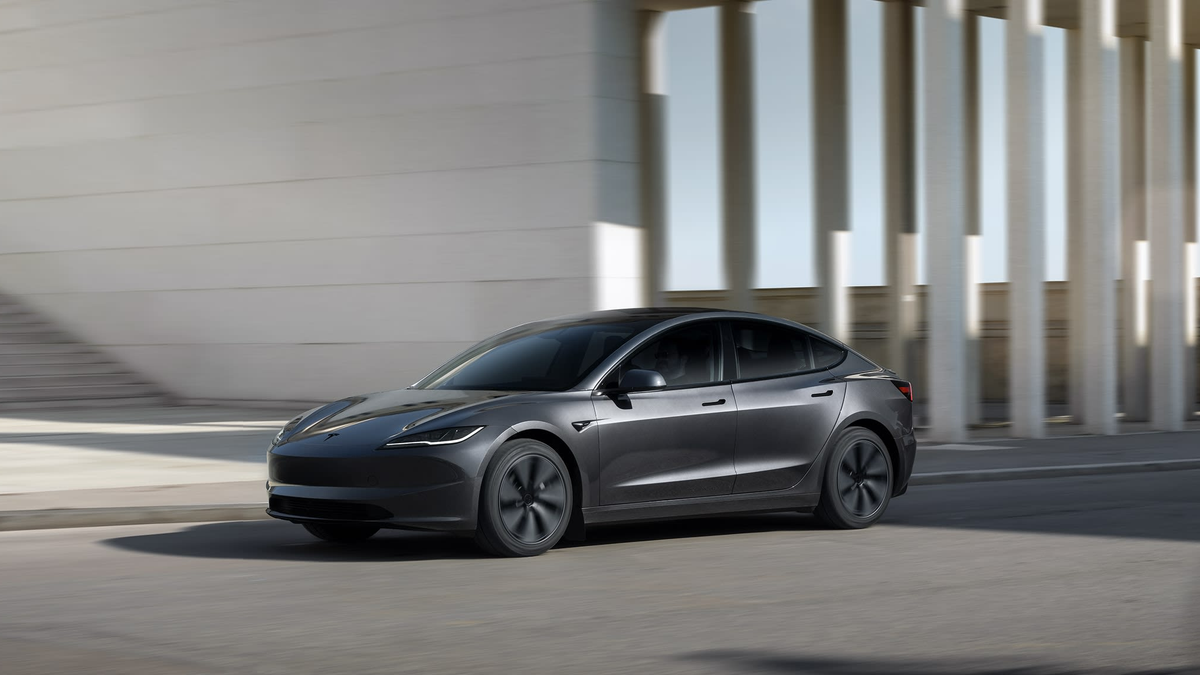
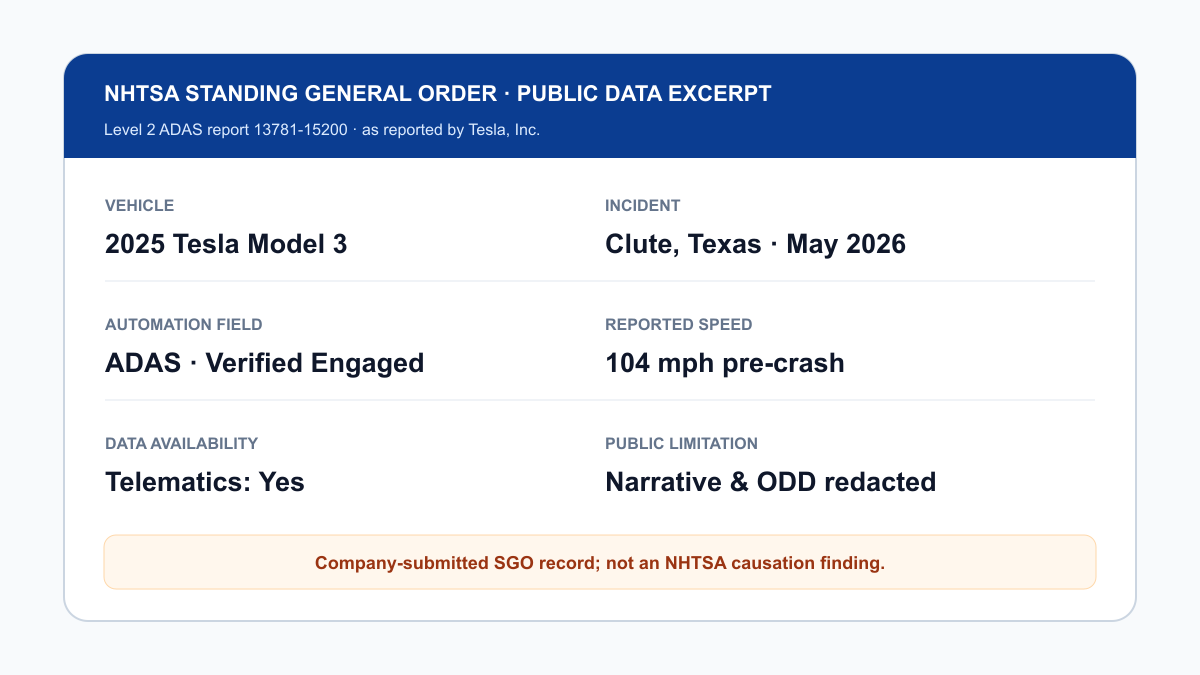
A Tesla-submitted NHTSA record says ADAS was verified engaged in a fatal 2025 Model 3 crash in Clute, Texas, in May 2026. It lists 104 mph pre-crash speed and telematics availability. The public file does not identify FSD or Autopilot and does not establish what caused the crash.
30-Second Brief
- NHTSA’s public Level 2 ADAS CSV contains one matching record, report 13781-15200, submitted by Tesla for a May 2026 crash in Clute, Texas.
- The record identifies a 2025 Model 3, a fatality, ADAS and the engagement status “Verified Engaged.”
- It lists 104 mph as the subject vehicle’s pre-crash speed and marks telematics data as available.
- The automation feature version, operational-design-domain field and narrative are redacted. The file cannot distinguish Autopilot from FSD.
- Engagement does not prove causation. Local reporting relayed a preliminary police belief that the driver suffered a medical episode, but the public evidence reviewed here does not establish a final cause.
What Happened
Electrek reported the NHTSA row on August 31 after reviewing the agency’s Standing General Order dataset. Tesstudio independently downloaded the official CSV and matched report 13781-15200 by report ID, city, model, model year and speed.
ABC13 reported that the May 20 crash left Brazoswood Drive, passed through a fence at Clute Municipal Park and entered the decommissioned pool area before the vehicle caught fire. The outlet quoted Clute police’s preliminary belief that a medical episode occurred. That account did not identify driver assistance or publish a speed.
What Is Confirmed
- Reporting entity and vehicle: The public row names Tesla, Inc., a 2025 Tesla Model 3 and a consumer driver.
- Location and period: The row lists Clute, Texas, and May 2026. NHTSA removes exact dates from the public file; ABC13 dates the crash to May 20.
- Automation field: “Automation System Engaged?” is ADAS and “Engagement Status” is “Verified Engaged.” This is information Tesla submitted under the SGO framework.
- Outcome and speed fields: The row lists fatality as the highest alleged injury severity and 104 mph as pre-crash speed.
- Available data: The file marks telematics as available. The source field is marked media; EDR, police report and video are not marked available in the released row.
- Redactions: The feature version, whether the vehicle was within its operational design domain and the narrative are withheld as claimed confidential business information.
What Remains Unconfirmed
The released record does not say the assistance system caused or contributed to the crash. It does not show steering, braking, accelerator input, driver-monitoring status, road video or the sequence immediately before impact. A system can be engaged while a driver supplies accelerator input or takes over control.
The file also does not identify the feature as Full Self-Driving or Autopilot. “ADAS” is the public system category, while the version field is redacted. The 104 mph value is a reported data field, not proof that software selected that speed. Finally, the preliminary medical-episode explanation has not been reconciled in a public final investigation record reviewed for this brief.
Why It Matters
NHTSA’s SGO data are one of the few public sources showing when manufacturers report driver-assistance engagement near serious crashes. The same page warns that reports can be incomplete, that reporting entities have different access to telemetry and that the data are not normalized by vehicle count or miles driven.
For safety reporting, the disciplined conclusion is narrow: Tesla reported verified ADAS engagement in this incident. Determining cause requires evidence that the public CSV does not contain. That distinction protects both the public’s right to know about engagement and the integrity of the investigation.
What Tesla Owners Should Know
- Treat assistance as supervised. Tesla’s Model 3 manual says Autosteer requires an attentive driver who is ready to take immediate action.
- Do not use engagement as a cause label. A crash report can show a system was on without proving it initiated the maneuver or speed.
- Take over whenever conditions look unsafe. Brake, steer or disengage the feature as appropriate; do not wait for the system to resolve an obvious hazard.
- Keep cameras unobstructed. Tesla warns that dirt, weather and faded markings can affect feature availability and performance.
- Preserve evidence after an incident. Save available dashcam clips, photograph the scene when safe and provide accurate information to police, insurers and NHTSA.
- Report suspected safety defects. Owners can file a complaint through NHTSA’s vehicle-safety reporting channel.
Tesstudio Analysis
Tesstudio scores this development 89.4 because a fresh specialist report surfaced a specific, readable Tier 0 NHTSA record about a fatal crash, and local reporting independently confirms the incident. The evidence is sufficient to report engagement and the public data fields, but not to assign causation or name the redacted feature.
The editorial test is whether every strong verb maps to a field. “Verified engaged” does. “Caused,” “drove at 104 mph” and “FSD crash” do not. Any later police finding, NHTSA investigation, unredacted data or Tesla statement should be added to this event page rather than spun into a duplicate.
Sources & Reporting Notes
- NHTSA: Standing General Order on Crash Reporting — primary explanation of reporting requirements, limitations, redactions and public data.
- NHTSA: Level 2 ADAS Incident Report Data — primary CSV containing report 13781-15200.
- Tesla Model 3 Owner’s Manual: Autosteer — company instructions on supervision, intervention and feature limitations.
- ABC13 Houston: Clute Municipal Park crash report — independent local reporting based on Clute police and the school district.
- Electrek: August 31 NHTSA-record report — specialist report that surfaced the record and prompted this independent verification.
Reporting note: NHTSA says public SGO data reproduce information submitted by reporting entities except protected or redacted fields and should not be treated as a normalized safety-rate dataset. Tesstudio matched the report directly and labels Tesla-submitted fields as such. The victim’s name is omitted from the body because it is not needed to explain the public-safety evidence.
Update & Correction Log
August 31, 2026: Initial publication. The brief distinguishes verified engagement from causation, avoids naming the redacted feature and identifies the 104 mph value as a company-submitted public-record field.


コメントを書く
このサイトはhCaptchaによって保護されており、hCaptchaプライバシーポリシーおよび利用規約が適用されます。