
SpaceX Says AI Revenue Could Lead by September—What Musk’s 10 GW Plan Means
Confirmed Address · Forward-Looking Company Claims
SpaceX AI revenue could exceed the company’s other revenue lines as soon as September, according to Elon Musk’s new staff address. Musk also described a SpaceX 10 GW compute plan for the end of 2027 and said Grok SpaceX employee data would help train the company’s AI. These are material Elon Musk SpaceX AI strategy claims, but they are forecasts—not reported results.
30-Second Brief
- SpaceX published an approximately 29-minute company update on its official X account on August 11.
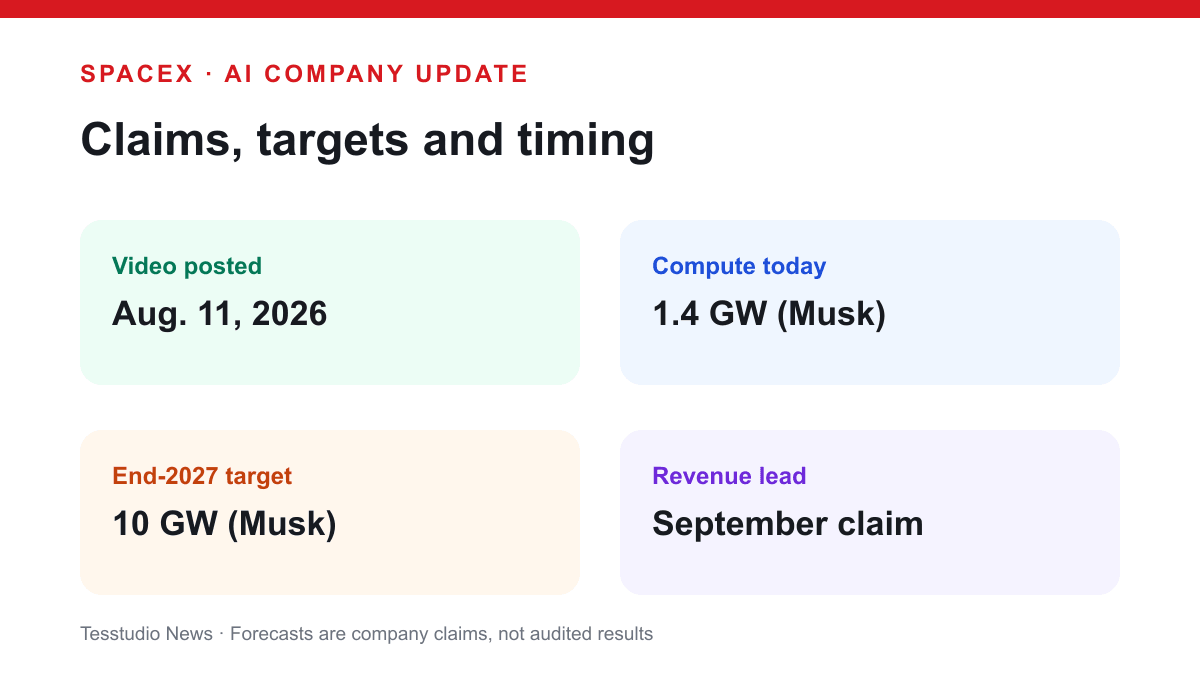
- Musk said AI revenue could overtake SpaceX’s other business lines in September and widen its lead during the fourth quarter.
- He described about 1.4 gigawatts of current AI compute and a target near 10 gigawatts by the end of 2027.
- Musk linked that capacity target to a possible $300 billion to $500 billion annual revenue range. That is a management scenario, not audited guidance or achieved revenue.
- He also said Grok would be trained on SpaceX information, including employee contributions. The exact data scope, consent controls and implementation were not disclosed.
What Happened
SpaceX made a company-wide address public on August 11, giving investors and technology watchers a clearer view of how Musk is ranking the company’s priorities after the integration of xAI. The message was not that rockets or Starlink are being abandoned. It was that terrestrial AI compute and Grok could become the largest near-term source of economic value inside the combined business.
Fresh reporting in the six-hour recovery window focused on two parts of the same event. Business Insider examined Musk’s plan to train Grok on SpaceX information and employee contributions. Teslarati focused on the capacity and revenue targets. We treat those stories as one event cluster anchored to the official video.
What Is Confirmed
- Primary source: SpaceX posted the address on its official account at 21:04 UTC on August 11.
- Strategic emphasis: Musk presented AI compute and Grok as central to SpaceX’s future growth and as a funding engine for longer-horizon space goals.
- Training-data plan: Musk said Grok would be trained on SpaceX information and encouraged employees to use the system and contribute to improving it.
- Risk context: SpaceX’s public offering disclosures already describe the AI segment as capital intensive, loss-making and exposed to uncertain demand and execution.
What Remains Unconfirmed
The address does not independently establish that SpaceX currently has exactly 1.4 gigawatts of usable, revenue-generating compute. It also does not provide the utilization rate, customer mix, contract duration, power availability, chip delivery schedule or capital expenditure required to reach 10 gigawatts.
The September crossover is especially important to label correctly. Musk described what he expects AI revenue to do; SpaceX did not publish a segment-by-segment September forecast or audited month-to-date results with the video. The $300 billion to $500 billion annual scenario depends on capacity, pricing and demand assumptions that may change substantially.
SpaceX also has not explained which employee records or work products could be used for Grok training, whether private communications are excluded, how access is governed, or what opt-out and retention controls apply.
Why It Matters
A 10-gigawatt AI fleet would be infrastructure on a utility scale. Reaching it by the end of 2027 would require coordinated access to accelerators, power, cooling, networking, construction and paying customers. The claim therefore reaches beyond model development: it is also an energy, supply-chain and capital-allocation story.
The address matters to Tesla followers because the companies increasingly share an infrastructure narrative through chips, AI systems and Terafab. That connection does not make SpaceX’s forecast a Tesla product announcement, but it may influence how Musk allocates engineering attention, manufacturing capacity and capital across his companies.
What Tesla Owners Should Know
- No vehicle change was announced. The address does not change FSD availability, Tesla vehicle hardware, pricing, charging access or owner support.
- Do not infer a Grok feature release. Training Grok on SpaceX information is different from shipping a new in-car assistant or autonomy capability.
- Watch for formal disclosures. The next useful checkpoints are reported AI-segment revenue, disclosed compute capacity, customer concentration and capital spending—not another headline forecast.
- Separate company boundaries. SpaceX, xAI and Tesla may collaborate, but each claim should be tied to the entity that actually announced it.
Tesstudio Analysis
The new information is the compression of the timeline. Musk is not merely saying AI may become important to SpaceX over several years; he is forecasting a revenue crossover within weeks and a roughly sevenfold compute expansion by the end of next year. That makes the address newsworthy even though much of the broader AI strategy was already public.
Our assessment is that the 10-gigawatt target is the more useful metric because it can be checked against power, construction and hardware milestones. The $300 billion to $500 billion revenue scenario is much less decision-ready without utilization and pricing assumptions. Readers should treat both as company claims until SpaceX reports measurable progress.
Related Tesla News Resources
Follow the Tesstudio Tesla News hub for verified Tesla, SpaceX, Starlink and xAI updates. This article contains no Related Gear placement because the event has no strong connection to a Tesstudio product or an immediate Tesla owner purchase decision.
Sources & Reporting Notes
- SpaceX: August 11 company update video — primary source for what Musk told employees.
- Business Insider: Grok training on SpaceX information and employee contributions — independent reporting published inside the recovery window.
- Teslarati: SpaceX AI capacity and revenue claims from the address — specialist corroboration of the same event.
- SEC-filed SpaceX disclosure — primary risk context for the company’s AI segment and capital requirements.
Reporting note: We verified that the address was published by SpaceX and used independent coverage to cross-check its themes. Capacity, timing and revenue figures are explicitly labeled as Musk’s forward-looking claims. Paid-media text was not reproduced.
Update & Correction Log
August 12, 2026: Initial publication. The article distinguishes the existence and content of the official address from unverified capacity and revenue outcomes.


コメントを書く
このサイトはhCaptchaによって保護されており、hCaptchaプライバシーポリシーおよび利用規約が適用されます。