
2026 Tesla Model Y Passes NHTSA’s New ADAS Tests: What Owners Should Know
Confirmed · NHTSA Primary Source
2026 Tesla Model Y safety reached a new benchmark: NHTSA says the later-release vehicle passed all eight NHTSA ADAS tests in its updated program. For shoppers comparing Tesla Model Y driver-assistance systems, the key boundary is the stated production cutoff—November 12, 2025—and the result does not equal autonomous-driving approval.
30-Second Brief
- NHTSA says the later-release 2026 Model Y passed four new ADAS tests plus four existing crash-avoidance criteria.
- The newly added tests cover pedestrian automatic emergency braking, lane keeping assistance, blind-spot warning and blind-spot intervention.
- The qualifying production cutoff is November 12, 2025; owners should verify their specific build and VIN rather than assuming every 2026 Model Y is included.
- The result does not make the vehicle autonomous. NHTSA says driver-assistance systems require an attentive driver who remains in control.
What Happened
On May 7, 2026, the U.S. National Highway Traffic Safety Administration announced that the “later release” 2026 Tesla Model Y had become the first vehicle model to pass the agency’s expanded pass/fail benchmark for advanced driver-assistance systems. The evaluations are part of NHTSA’s New Car Assessment Program, the same consumer-information program associated with the agency’s vehicle safety ratings.
The qualifying Model Y passed four newly integrated tests:
| ADAS test | What the system is designed to do |
|---|---|
| Pedestrian automatic emergency braking | Detect a pedestrian ahead and automatically brake when a collision is imminent. |
| Lane keeping assistance | Apply corrective assistance to help prevent an unintended lane departure. |
| Blind-spot warning | Warn the driver when another vehicle is detected in a blind spot. |
| Blind-spot intervention | Apply braking or steering assistance if the vehicle begins moving toward an occupied adjacent lane. |
NHTSA also reported that the Model Y passed the program’s four earlier ADAS criteria: forward-collision warning, crash-imminent braking, dynamic brake support and lane-departure warning.
What Is Confirmed
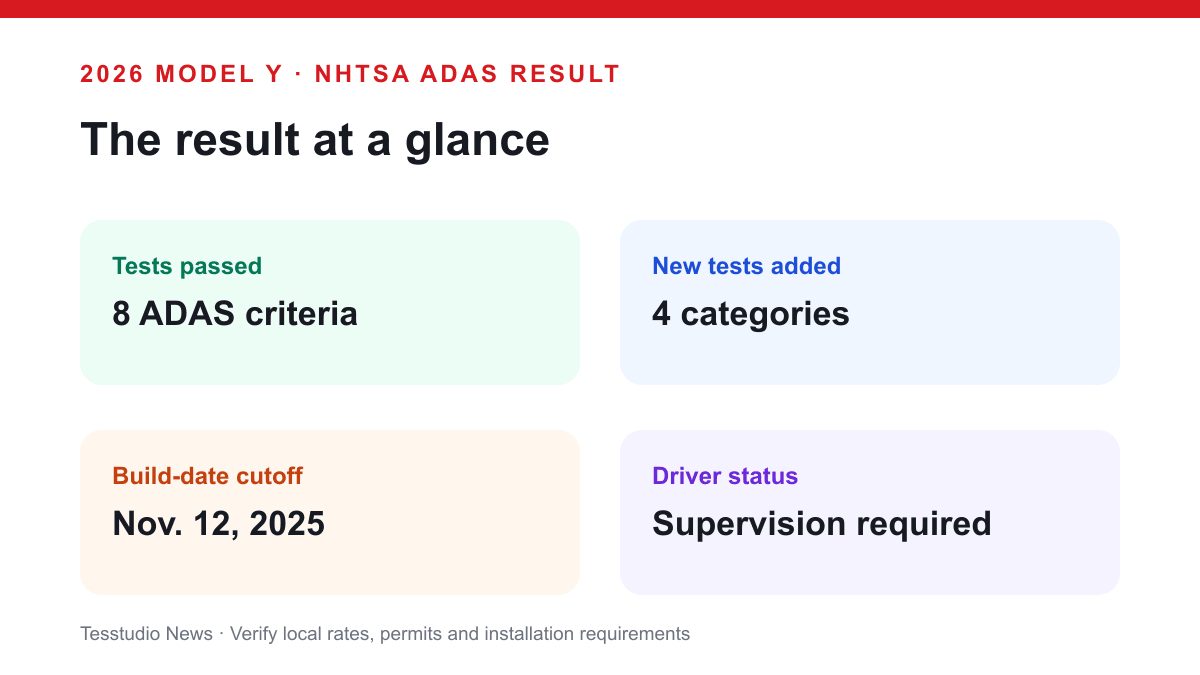
- Vehicle scope: NHTSA identifies the later-release 2026 Tesla Model Y manufactured on or after November 12, 2025.
- Test scope: Eight driver-assistance and crash-avoidance criteria were passed.
- Program: The evaluations sit within NHTSA’s updated NCAP consumer testing framework.
- Driver responsibility: The agency describes these systems as assistance technologies and says the driver must remain attentive and in control.
What Remains Unconfirmed
The announcement does not establish that every Model Y sold globally has the same hardware, software or regulatory test result. It also does not say that an older Model Y automatically gains the same tested status through an over-the-air update. NHTSA’s announcement should not be read as a blanket claim about Full Self-Driving (Supervised), unsupervised autonomy, every driving condition or the vehicle’s overall crash rating.
Why It Matters
For buyers, the new pass/fail format makes specific driver-assistance performance easier to distinguish from broad marketing terms. For current owners, the most useful takeaway is narrower: the tested later-release 2026 Model Y met NHTSA’s defined criteria in a controlled government assessment. That is stronger evidence than an isolated owner video, but it is not a promise that the systems will prevent every collision.
The result also gives shoppers a more concrete comparison point. As more vehicles enter the updated program, buyers will be able to compare whether competing models pass the same defined tests instead of relying only on feature names that vary by manufacturer.
What Tesla Owners Should Know
- Check the build date. The NHTSA announcement specifies vehicles manufactured on or after November 12, 2025. The certification label on the driver-side door jamb shows the vehicle’s manufacture date; a VIN-specific question should be checked with Tesla or NHTSA.
- Keep cameras clean and unobstructed. Driver-assistance performance can depend on visibility and operating conditions. Follow Tesla’s owner documentation rather than adding anything that blocks cameras or sensors.
- Read in-car release notes. Software behavior and availability can change by vehicle, hardware, region and release.
- Stay responsible for the drive. A passed ADAS test is not permission to disengage from supervision.
Tesstudio Analysis
The most important part of this news is not the “first” headline; it is the tighter definition of what was actually evaluated. Eight named tests, a stated production cutoff and a government source give owners a useful evidence boundary. Tesstudio will treat future software or hardware claims separately unless NHTSA or Tesla documents that they apply to the same tested configuration.
From a buying perspective, this result strengthens the case for asking configuration-specific questions: Which production version was tested? Which market? Which features were active? A careful answer is more useful than treating “Model Y” as one permanent specification across all years and regions.
Related Model Y Resources
This safety result is independent of aftermarket products. Owners looking for non-safety-related organization, comfort and protection options can browse the Tesla Model Y accessories collection. Always confirm the model year and fitment shown on each product page; accessories should never cover or interfere with cameras, warning indicators or driver controls.
Sources & Reporting Notes
- NHTSA: 2026 Tesla Model Y passes the agency’s new ADAS tests — primary announcement, May 7, 2026.
- NHTSA: Driver Assistance Technologies — official definitions and driver-responsibility guidance.
- NHTSA: Vehicle Safety Ratings — official NCAP and ratings context.
Reporting note: This article summarizes public NHTSA records and adds owner-focused analysis. Tesstudio did not conduct the government tests and is not affiliated with Tesla, Inc. or NHTSA.
Update & Correction Log
August 12, 2026: Initial publication. The article distinguishes the ADAS pass/fail result from autonomous-driving approval and a complete five-star crash rating.
August 12, 2026: Added two inline visuals, an answer-first keyword summary and color-coded evidence modules for faster reading; the underlying facts and sources are unchanged.


コメントを書く
このサイトはhCaptchaによって保護されており、hCaptchaプライバシーポリシーおよび利用規約が適用されます。