
Verified Brief: FAA Completes Starship Pacific Reentry Environmental Review
Verified Brief · FAA Final Environmental Record · September 4, 2026
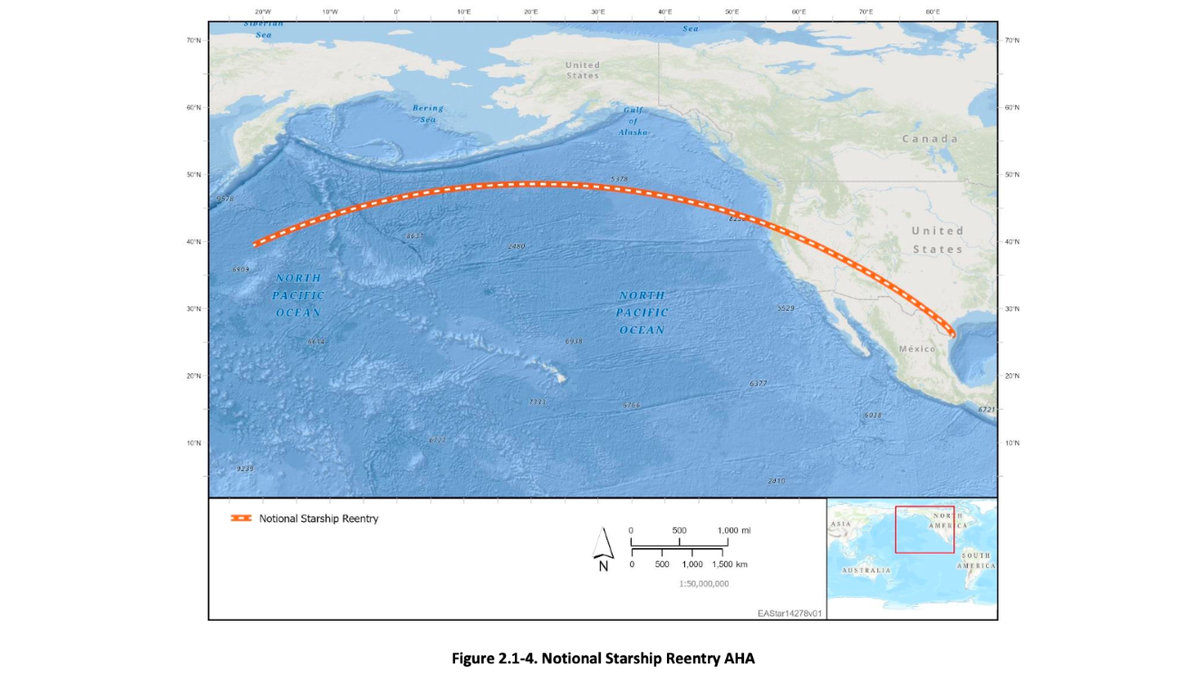
The FAA Starship environmental review is complete for expanded Pacific contingency landing areas and an additional Starship reentry path to Starbase. The final record is an important regulatory milestone, but it is not a Starship flight license: the Federal Register says SpaceX must still obtain a modification to its existing vehicle operator license.
30-Second Brief
- The FAA posted the Final Tiered Environmental Assessment and Finding of No Significant Impact/Record of Decision for Starship reentry contingency operations in the Pacific Ocean and another landing trajectory to Starbase.
- The reviewed action expands the Hawaii and Central Pacific area and the Southeast Pacific area, and adds a Northern Pacific contingency area for an Eastern Range-to-Starbase trajectory.
- The record also evaluates temporary airspace closures associated with an additional Starship reentry path to Boca Chica/Starbase, Texas.
- The Federal Register notice is dated September 2 and published September 4, 2026. FAA says it received 37 comments during the draft-review period.
- SpaceX still needs an FAA vehicle-operator-license modification. The record does not authorize a particular flight, launch date or ship catch.
What Happened
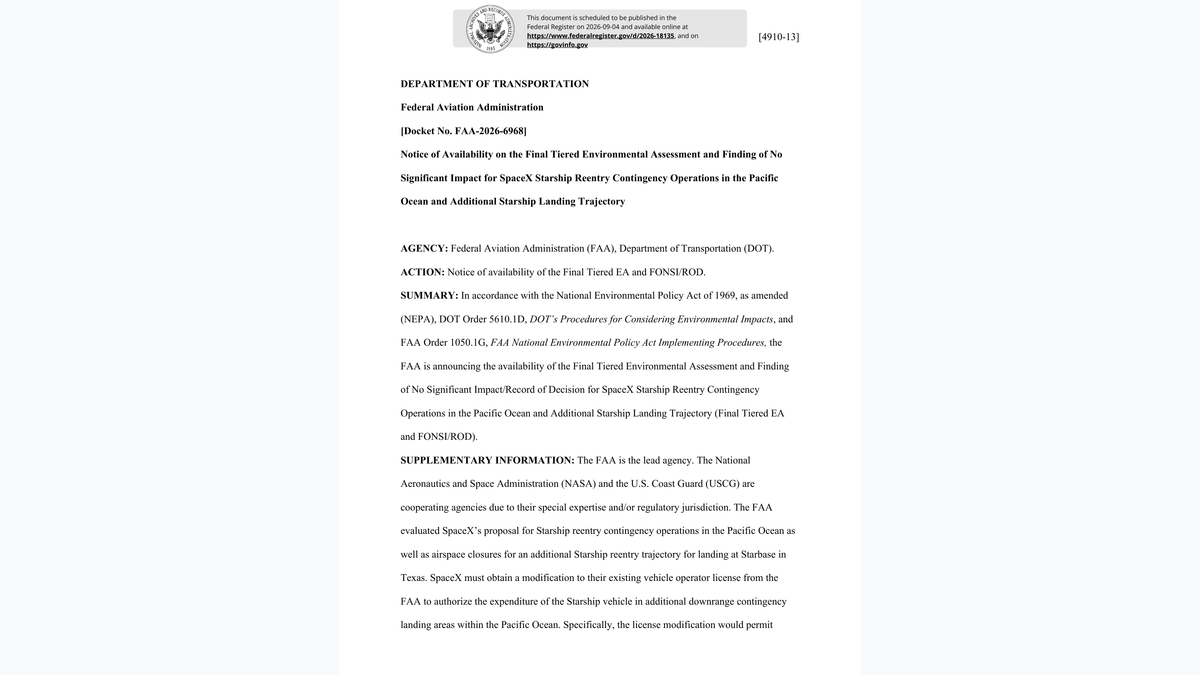
The FAA moved Docket FAA-2026-6968 from a draft environmental review to a final decision record. The agency's Starship project page now labels the Final Tiered EA and FONSI/ROD complete, while the September 4 Federal Register notice formally announces their availability.
The review concerns contingency options if a Starship cannot complete its intended recovery and the airspace planning for another reentry route to Starbase. It does not change the status of any specific flight on its own.
What Is Confirmed
- Final environmental record: FAA published the Final Tiered EA and a Finding of No Significant Impact/Record of Decision.
- Existing areas expanded: The reviewed action expands the previously evaluated Hawaii and Central Pacific landing area and the Southeast Pacific landing area.
- New area added: It adds a Northern Pacific contingency landing area in the Northeast Pacific for an Eastern Range-to-Starbase trajectory.
- Airspace component: FAA evaluated temporary airspace closures associated with an additional reentry trajectory to the Boca Chica Launch Site in Starbase, Texas.
- Public process: The draft review ran from July 13 through August 3 after a one-week extension. FAA says it received 37 comments and considered them in preparing the final record.
- License boundary: The Federal Register says SpaceX must obtain a modification to its existing vehicle operator license to authorize the added downrange contingency operations.
What Remains Unconfirmed
The documents do not establish that the FAA has issued the required operator-license modification. They also do not approve a specific Starship flight, identify a launch date, authorize a catch attempt, or show that SpaceX will use every reviewed contingency landing area.
The notional trajectory and aircraft hazard area are planning inputs, not a public flight schedule. Operational airspace closures, mission-specific licensing and any separate safety review remain distinct steps.
Why It Matters
A final environmental decision narrows one major regulatory uncertainty around a broader Starship operating envelope. Contingency areas matter because a reusable vehicle needs planned options when the nominal recovery site or vehicle conditions make the intended landing unavailable.
The additional reentry path also has airspace implications across a large geographic corridor. FAA's review creates the environmental record for those options, while the remaining license-modification requirement preserves a clear distinction between environmental completion and permission to conduct an operation.
What Tesla Owners Should Know
This is a SpaceX regulatory development and requires no action from Tesla vehicle owners. It does not change Tesla vehicle software, charging, service, pricing or recall status. Readers following Elon Musk's companies should treat it as a Starship program milestone, not as an announcement of a launch or a new consumer product.
- Track the license, not only the environmental record. A future FAA license modification would be the more direct authorization signal.
- Ignore unsupported launch-date claims. The documents do not schedule a flight.
- Read maps as planning material. A notional route or hazard area is not proof that the route will be used on the next mission.
Tesstudio Analysis
Tesstudio scores this event 88.25. It clears the normal-mode scheduled-publication threshold because the development is current, documented by multiple readable FAA records and independently matched by Aviation Week. The strongest value is precision: the final environmental review broadens the set of operations FAA can consider, but the Federal Register explicitly preserves the need for a vehicle-operator-license modification.
The right headline is therefore “environmental review complete,” not “Starship approved to fly.” That distinction avoids turning a real regulatory milestone into an unsupported launch-authorization claim.
Sources & Reporting Notes
- FAA: SpaceX Starship/Super Heavy project at Boca Chica — primary project page listing the final review and the three scoped changes.
- Federal Register: Notice 2026-18135 — official September 4 notice, docket number, comment record and license-modification boundary.
- FAA: Final Tiered Environmental Assessment — primary environmental analysis.
- FAA: Finding of No Significant Impact / Record of Decision — primary environmental decision record.
- Aviation Week: FAA Authorizes a Wider Swath for Starship Ops — independent September 2 corroboration.
Reporting note: The FAA and Federal Register are treated as the controlling sources. Aviation Week is used only as independent corroboration. Tesstudio does not infer a flight license, mission date, catch approval or operational use beyond the official record.
Update & Correction Log
September 4, 2026: Initial publication based on FAA's final environmental record, the Federal Register notice and independent aerospace reporting. The article states prominently that a separate operator-license modification is still required.




Hinterlasse einen Kommentar
Diese Website ist durch hCaptcha geschützt und es gelten die allgemeinen Geschäftsbedingungen und Datenschutzbestimmungen von hCaptcha.