
FCC Publishes Satellite D2D Spectrum Proposal That Cites SpaceX
Confirmed · FCC Proposed Rule Published
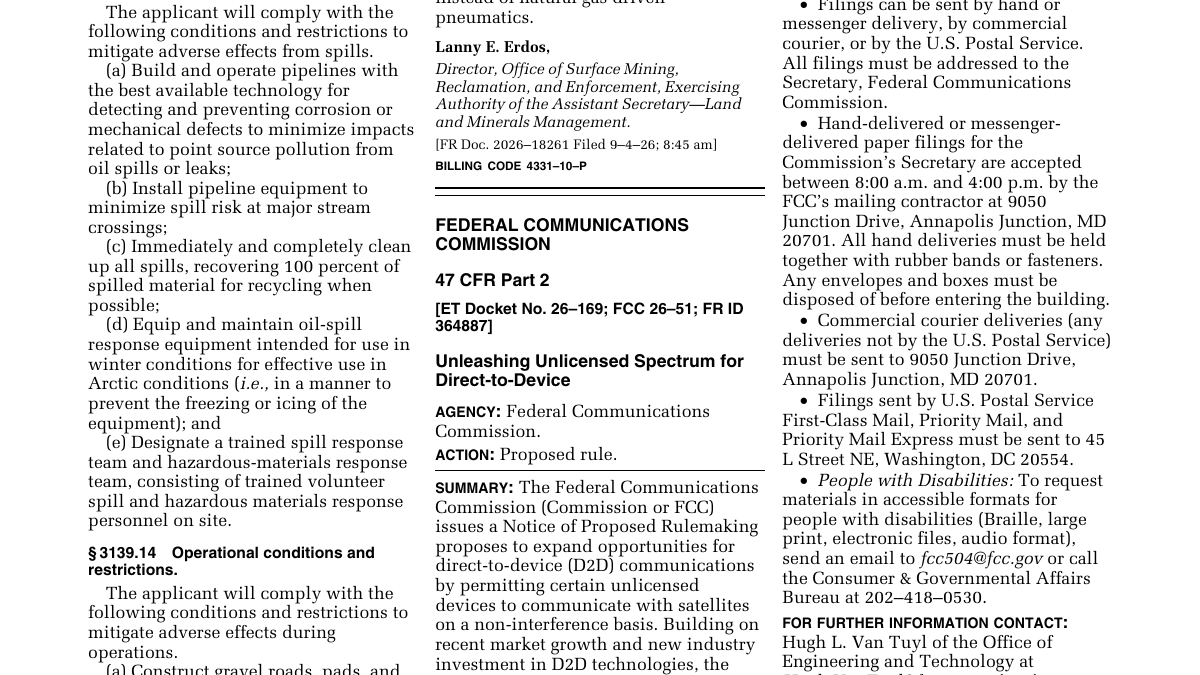
The FCC satellite D2D proposal entered the Federal Register on September 8, opening comments on possible unlicensed direct-to-device spectrum. The record cites SpaceX’s EchoStar spectrum deal, but it does not approve new Starlink mobile service, assign capacity to SpaceX or change any customer plan.
30-Second Brief
- The FCC published proposed rule 2026-18282, also known as FCC 26-51 and ET Docket 26-169, in the Federal Register on September 8, 2026.
- The agency is considering satellite communication with certain devices in the 2.4 GHz and 5.8 GHz unlicensed bands, subject to non-interference conditions and a future licensing framework.
- The FCC cites SpaceX’s $19.6 billion acquisition of 65 megahertz of EchoStar D2D spectrum in 2025 as market context.
- The proposal does not authorize SpaceX to use the new bands, does not modify an existing Starlink license and does not activate a consumer feature.
- Initial comments are due November 9; reply comments are due December 7.
What Happened
The Federal Register published the FCC’s “Unleashing Unlicensed Spectrum for Direct-to-Device” Notice of Proposed Rulemaking on September 8. The Commission adopted the item August 6 and released FCC 26-51 on August 7; publication now supplies the fixed public-comment deadlines.
The FCC is asking whether satellites should be permitted to communicate with equipment operating under Part 15 technical rules in the 2400–2483.5 MHz and 5725–5850 MHz bands. Its proposed allocations would be unprotected and non-interference-based, meaning authorized incumbent services retain priority.
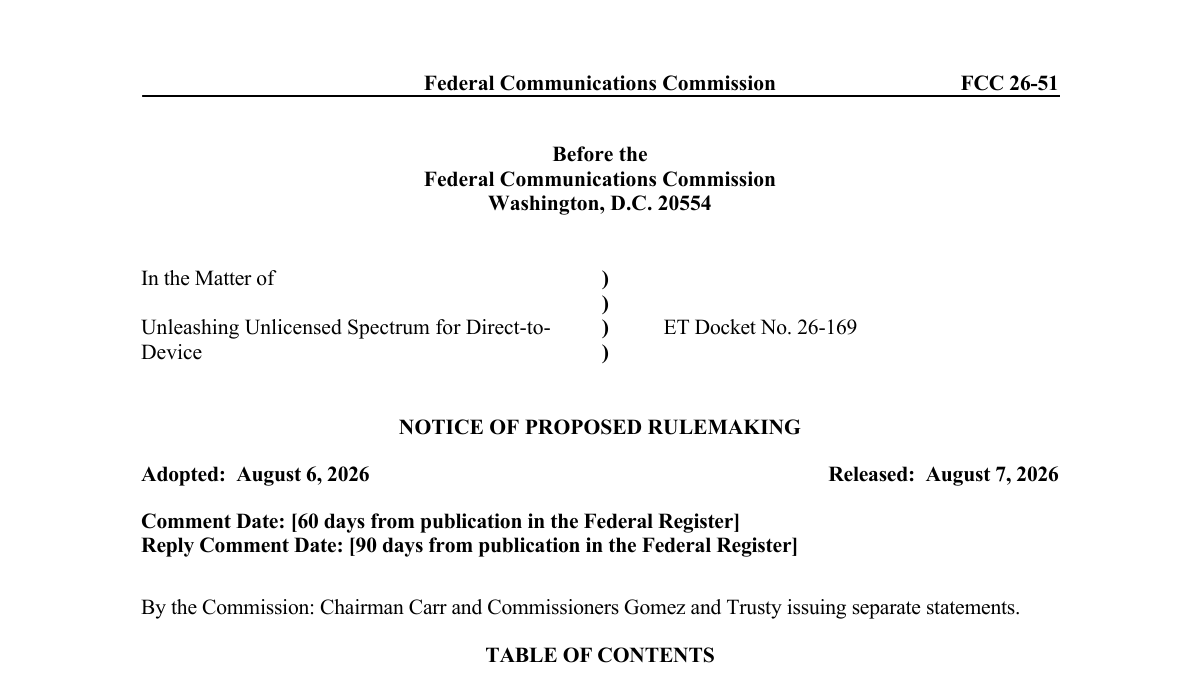
What Is Confirmed
- Document status: FCC 26-51 is a Notice of Proposed Rulemaking, not a final rule.
- Candidate bands: the FCC proposes Earth-to-space allocations in 2400–2483.5 MHz and 5725–5850 MHz and seeks input on other satellite uses.
- Operating condition: the proposed framework would require operations to avoid harmful interference and accept interference from incumbent and Part 15 users.
- SpaceX reference: the FCC says SpaceX acquired 65 megahertz of D2D spectrum from EchoStar for $19.6 billion in 2025. That figure is background in the agency’s market discussion.
- Deadlines: comments are due November 9, 2026; reply comments are due December 7, 2026.
What Remains Unconfirmed
The FCC has not decided whether to adopt final allocations or which licensing mechanism would apply. It is considering alternatives including license-by-rule and blanket licensing, along with equipment certification, interference protection, international coordination and national-security questions.
SpaceX has not announced in the reviewed sources that Starlink will use these unlicensed bands. The proceeding does not establish device compatibility, deployment timing, network performance or pricing. Connecting billions of existing Wi-Fi or Bluetooth devices to satellites is presented as a possibility for comment, not a delivered capability.
Why It Matters
Direct-to-device satellite service is constrained by spectrum, device radios and licensing. The proposal explores whether widely used unlicensed bands could supplement licensed mobile-satellite routes, potentially lowering barriers for future devices and services while imposing strict non-interference limits.
For SpaceX watchers, the most important signal is regulatory direction rather than an immediate Starlink product change. The FCC explicitly places SpaceX’s expensive licensed-spectrum acquisition beside a proposal for an additional unlicensed pathway. Whether SpaceX participates—and under what technical design—remains open.
What Tesla Owners Should Know
- No action is required. The notice does not change a Tesla vehicle, phone, Starlink terminal or subscription.
- Do not infer compatibility. Existing Wi-Fi and Bluetooth hardware is not automatically satellite-ready because the FCC is considering new allocations.
- Track the docket, not rumors. Material next steps would include SpaceX comments, a final FCC rule, license applications or an official Starlink product announcement.
- Read “unlicensed” carefully. It describes the device bands and proposed authorization approach; satellite operators would still operate under FCC oversight and interference rules.
- Separate market context from approval. The SpaceX transaction is cited to illustrate D2D investment, not to award SpaceX rights in this proceeding.
Tesstudio Analysis
Tesstudio scores this regulatory update 82.75. Authority and factual confidence are high because the Federal Register notice, FCC order and FCC fact sheet are readable primary records. Timeliness is tied to the September 8 publication and fixed comment deadlines, while owner impact is lower because no service changes today.
The correct editorial frame is narrow: the FCC published an industry-wide proposal that names SpaceX as market context. Calling it a Starlink approval, spectrum award or rollout would overstate the record. The milestone to watch is whether SpaceX files substantive comments by November 9 or later seeks authority under any final framework.
Sources & Reporting Notes
- Federal Register: Unleashing Unlicensed Spectrum for Direct-to-Device — September 8 publication, proposal summary, bands and comment deadlines.
- FCC 26-51: Notice of Proposed Rulemaking — complete primary record adopted August 6 and released August 7, including the SpaceX transaction reference.
- FCC fact sheet for ET Docket 26-169 — primary overview of the proposed D2D framework.
- Converge Digest: independent industry context — earlier report describing the same FCC proposal and its SpaceX reference.
Reporting note: The Federal Register document is dated September 8, 2026. Tesstudio published this article on September 7 in America/Los_Angeles because the federal publication date begins before midnight Pacific time. The proposal itself was adopted August 6 and released August 7. Both visuals are public-record document excerpts rendered and cropped without generative alteration.
Update & Correction Log
September 7, 2026 (America/Los_Angeles): Initial publication. The article distinguishes Federal Register publication from FCC adoption and separates the SpaceX market reference from any Starlink authorization.


اترك تعليقًا
This site is protected by hCaptcha and the hCaptcha Privacy Policy and Terms of Service apply.